
 简体中文
简体中文 English
 Español
News
Beverage Refrigerator Temperature: Ideal Settings for Every Drink Type
Most of us never think about the temperature inside a drinks fridge until something goes wrong: a customer sends back a warm can, a bottle of white wine reaches the table tasting flat, or a delivery of milk sits a little too long in a cabinet that never quite got cold enough. In cafés, bars, convenience stores and supermarket aisles, the beverage refrigerator is quietly doing one of the most important jobs on the floor. Get the setting right and every drink tastes the way your customer expects. Get it wrong and you are either freezing your stock or selling lukewarm soda all day.
Why Beverage Refrigerator Temperature Matters
Cold is not just a comfort factor. Temperature changes how a drink tastes, how long it lasts and how much it costs you to keep it. A beer poured at 4°C (39°F) tastes crisp and clean, while the same beer at 12°C (54°F) can seem sweet and heavy, because warmth releases aromas and softens carbonation. White wine loses its freshness if it is served too warm and its perfume if it is served too cold. Soft drinks go flat faster in a cabinet that swings between temperatures.
For food safety, the rule is simple: milk, cream, fresh juice and any dairy-based drink should stay at or below 4°C (40°F), and never sit above 8°C (46°F) for long. For energy, every extra degree of cooling costs money, so a fridge running colder than it needs to is quietly adding to your electricity bill all year round.
Ideal Beverage Refrigerator Temperature at a Glance
Different drinks genuinely prefer different temperatures, but in practice one well-set cabinet covers most of them. The table below is the range we pass on to most of the shops and bars we work with.
| Drink | Ideal serving temperature (°C) | Ideal serving temperature (°F) |
|---|---|---|
| Light lager and mainstream beer | 3 to 7 | 37 to 45 |
| Craft ale, porter, stout | 7 to 12 | 45 to 54 |
| White wine and rosé | 6 to 10 | 43 to 50 |
| Sparkling wine | 6 to 8 | 43 to 46 |
| Red wine (light chill) | 13 to 16 | 55 to 61 |
| Soda, mixers and cola | 2 to 4 | 36 to 40 |
| Bottled water | 4 to 7 | 39 to 45 |
| Fresh juice | 4 to 7 | 39 to 45 |
| Milk and dairy drinks | 2 to 4 | 36 to 40 |
Notice that the spread is not wide. Most commercial beverage refrigerators sit happily between 34°F and 40°F, which keeps canned and bottled drinks icy without freezing them and keeps dairy safely chilled. Wine, especially red, is the exception and usually deserves its own cabinet.
What Should You Actually Set the Thermostat To?
If you stock a normal mix of soda, water, beer and juice, start at 38°F (3°C) and adjust from there. If your customers mostly buy mainstream lager, you can push down to 36°F (2°C) for a colder serve. If your range leans towards craft beer, cider or white wine, 41°F to 45°F (5°C to 7°C) will let those drinks show more of their character.
One thing worth knowing: the numbers printed on a mechanical dial are rarely accurate degrees. A dial set to "3" might give you 2°C or 6°C depending on the room, the load and how often the door opens. The only reliable way to know your beverage refrigerator's real temperature is to put a thermometer in the middle of the cabinet, close the door and leave it for a few hours. Do it once a season, and once more when the weather turns hot.
Matching the Setting to What You Sell
Beer
Light lagers and big brand beers are at their best between 37°F and 45°F (3°C and 7°C). Ales, porters and stouts usually want a few degrees more, around 45°F to 54°F (7°C to 12°C), where the malt and hop aromas come through instead of being shut down by the cold. When beer makes up a large share of your sales, a dedicated beer display cooler keeps the range steady even during a busy evening.
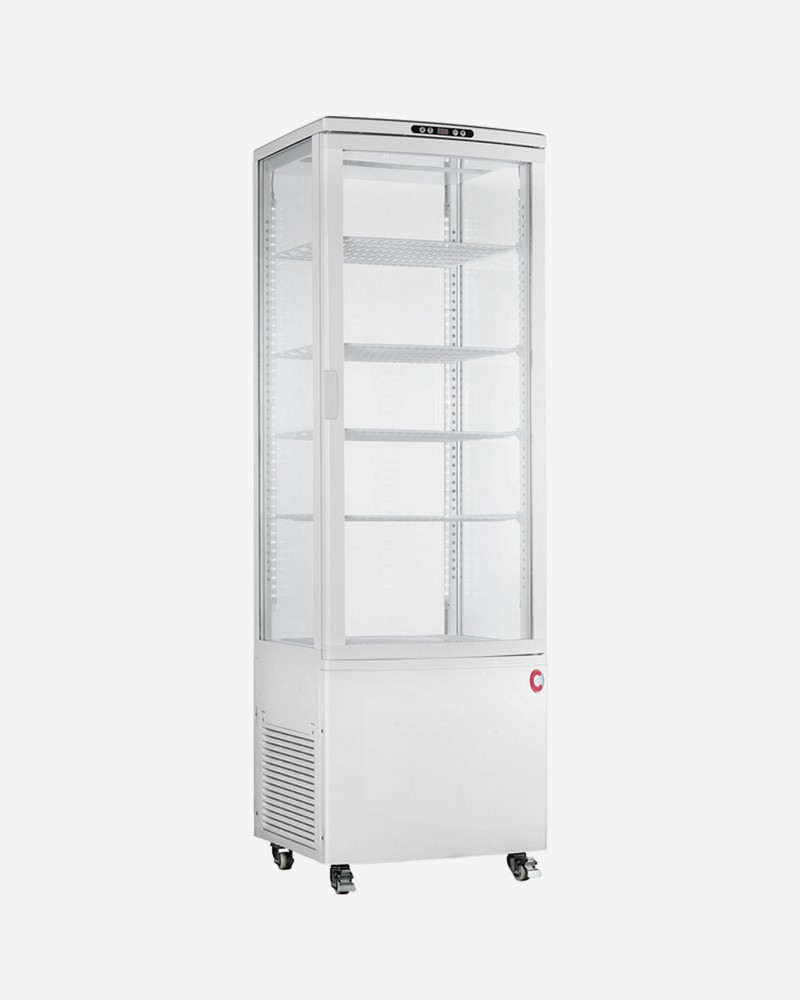 Countertop Four-Sided Glass Beer Display Cooler XC-218LA 218 L countertop beer and beverage chiller with four-sided double glass, 2–10°C range and ventilated cooling, suited to steady commercial beer display.View Product →
Wine
White and rosé wines sit comfortably at 43°F to 50°F (6°C to 10°C), and sparkling wine a touch colder at 43°F to 46°F (6°C to 8°C). Red wine is the odd one out: it is usually served at 55°F to 61°F (13°C to 16°C), well above what a beverage cooler is built for. A light chill is fine, but storing reds in the drinks fridge long term dulls them.
Soft drinks, water and juice
Cans and bottles of soda, sparkling water and still water are happiest between 36°F and 40°F (2°C to 4°C): cold enough to be refreshing, not so cold that the drink loses its fizz or freezes at the back. Fresh juice belongs in the same range as dairy, around 39°F (4°C), and should be treated as a perishable product with a short shelf life once opened.
 Countertop Beverage Display Cooler XCW-120ZA 135 L countertop cooler with 2–10°C range, sliding glass doors and chromed shelves, useful for chilled sodas, water and packaged drinks.View Product →
Milk, dairy and iced coffee
Anything containing milk belongs in the food-safety zone: 36°F to 40°F (2°C to 4°C) and no warmer. Keep these drinks away from the door and the top shelf, where temperatures fluctuate most during trading hours.
Open or Closed Cabinets: How the Style Affects Temperature
The cabinet you choose changes how hard the refrigeration system has to work. A closed cabinet with a glass door holds its temperature easily and recovers quickly after being opened. An open display cooler, the kind used in supermarkets and convenience stores, has no barrier between the cold air and the room, so it relies on a curtain of chilled air and needs a lower set point to keep the front row of drinks cold.
Neither style is better in every situation; it depends on how customers shop. If you want a longer explanation of the trade-offs, we wrote about it in our guide to open and closed display refrigeration. What matters for temperature is that open cabinets need more attention to draughts, air conditioning and doorways, while closed cabinets are more forgiving in a warm kitchen.
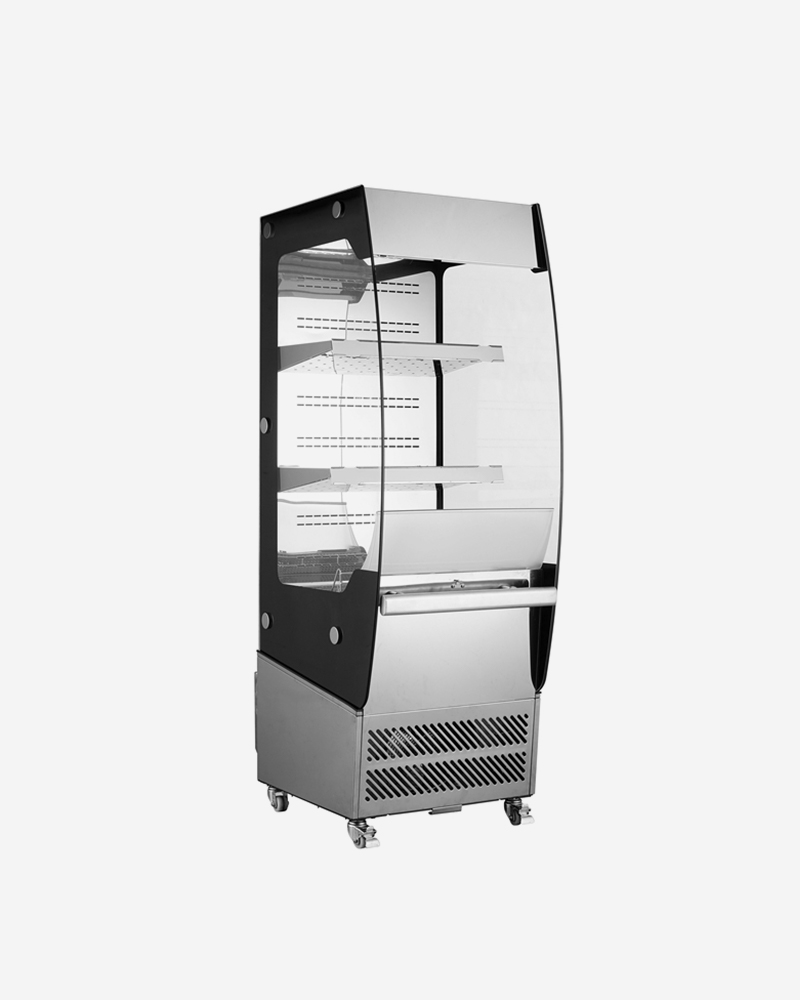 Commercial Stainless Steel Open Display Cooler XCS-180LA customizable 180 L open display cooler with 2–10°C range and 1340 W power, suited to commercial refrigerated display in busy retail settings.View Product →
Practical Steps to Hold the Right Temperature
A good set point is only half the job. These habits keep a beverage refrigerator where you want it:
- Use a thermometer rather than the dial to confirm the real temperature, and check it monthly.
- Leave space between rows and never block the air vents at the back or base of the cabinet.
- Load warm deliveries in small batches instead of filling the cabinet with room-temperature stock.
- Keep the cabinet out of direct sunlight and away from ovens, fryers and dishwashing areas.
- Replace worn door gaskets and clean condenser coils so the compressor is not working against itself.
- In summer, expect to adjust the setting slightly; a cabinet in a 30°C room behaves differently from one in a 20°C room.
Common Mistakes That Push Drinks Out of Range
Overloading the cabinet is the most frequent problem we see. Packed shelves block airflow, so the front drinks are cold while the back row is several degrees warmer. The second is leaving the door open during restocking; a cabinet open for ten minutes can take well over an hour to return to its set point. The third is trusting a single reading taken right after delivery, when the fridge is full of warm stock and the compressor has not caught up yet. Give any new cabinet 24 hours to settle before you judge its performance.
Questions We Hear From Shop and Bar Owners
Is 40°F cold enough for beer?
Yes. For most mainstream lagers, 40°F (4°C) is a good everyday serve. If you want a colder pour, 36°F to 38°F (2°C to 3°C) works well, but going much lower risks ice crystals and flat beer.
Why are the cans at the back of my fridge frozen?
Usually because the thermostat sensor sits near the front, or because the cabinet is underloaded and the compressor keeps running. Adding a few extra bottles and checking that nothing is pressed against the evaporator normally solves it.
Can I keep milk and soda in the same cooler?
Yes, as long as the cabinet holds 2°C to 4°C (36°F to 40°F). That range is cold enough for dairy and still pleasant for soft drinks. Just keep milk away from the door, where temperature swings are largest.
Getting the temperature right in a beverage refrigerator is not complicated, but it does reward a little attention: a thermometer you trust, a setting matched to what you sell, and a cabinet that can hold its range through a full trading day. For shops, cafés and bakery counters that need equipment built for commercial use rather than a domestic fridge, it helps to start with a quick look at what you sell, how fast it turns over and how warm your space gets in summer. Sankool has been manufacturing commercial display coolers, cake showcases and warming cabinets in Ningbo since 2007, and every unit is built to hold its temperature from opening to closing. You can see the full product range and match a cabinet to your drinks list.
You May Also Like
.jpg?imageView2/2/w/500/h/500/format/jp2/q/100 "Four Sides Glasses Display Cooler")
.jpg?imageView2/2/w/500/h/500/format/jp2/q/100 "White 4-Sided Glass Refrigerated Display Case")
.jpg?imageView2/2/w/500/h/500/format/jp2/q/100 "Refrigerated Display Cake Countertop Four Sides Glasses Display Cooler")
.jpg?imageView2/2/w/500/h/500/format/jp2/q/100 "Four Sides Glasses Display Cooler")

-
- Navigation
- Home
- About Us
- Products
- News
- Contact Us
 East Zone, Guanhaiwei Industrial Park, Cixi City, Ningbo, Zhejiang, China
 +86-574-63668678
 +86-574-63668108
Copyright © Ningbo XiangChi Electrical Co.,Ltd All Rights Reserved.
