
 简体中文
简体中文 English
 Español
News
Restaurant fridge organization: Applications, Selection Criteria, and Practical Guidance
Walk into a busy restaurant kitchen ten minutes before the dinner rush and you can usually tell how the night will go just by opening the refrigerator door. When everything has a home, cooks find what they need in seconds, nothing gets forgotten at the back of a shelf, and the line keeps moving. When it does not, tickets slow down, product gets thrown away, and someone spends the last hour of the shift scrubbing out a bin that should never have been messy in the first place.
We have spent years building commercial display refrigeration for bakeries, sushi bars, cafes, and restaurants, and the same question comes up in almost every conversation: what is the simplest way to keep a working fridge organized? The answer is not a longer to-do list. It is a system that matches your menu, your equipment, and the pace of your service.
Why Restaurant Fridge Organization Pays Off
Organization is not about tidiness for its own sake. A planned refrigerator directly affects three things every operator cares about: speed, cost, and safety.
- Faster service. When ingredients sit in predictable places, a cook does not have to hunt for a garnish in the middle of a rush.
- Less waste. Stock that is visible gets used before it expires, which is the cheapest way to lower food cost.
- Safer food. Raw proteins stored below ready-to-eat items cannot drip onto them, which is one of the most common causes of cross-contamination.
- Healthier equipment. An overloaded cabinet blocks the airflow that a commercial refrigerator depends on, so the compressor works harder and the whole unit ages faster.
Start With a Shelf-by-Shelf Map
Before you buy a single container, decide what belongs on each level. Cold air behaves predictably, and food safety guidance points in the same direction: the items that need the least cooking go highest, and the items that need the most cooking go lowest.
| Zone | What Belongs There | Why It Works |
|---|---|---|
| Top shelf | Ready-to-eat food, desserts, garnishes, cooked proteins | Nothing raw can drip down onto these items |
| Middle shelves | Prepped vegetables, dairy, whole cuts portioned that day | Eye level for the items used most often |
| Lower shelves | Raw fish, raw beef and pork, shell eggs | Keeps raw proteins below cooked and ready-to-eat food |
| Bottom shelf | Raw poultry and any thawing meat held in a tray | The highest-risk item sits at the lowest point |
| Drawers | Produce and delicate items that prefer higher humidity | Separate humidity control slows wilting |
| Door shelves | Condiments, sauces, drinks, sealed jars | The warmest spot, safe for shelf-stable and acidic items |
Print the map, tape it to the door, and train new hires against it during their first shift. A written map removes the guesswork that causes most of the mess in the first place.
Use Vertical Space Before You Buy Another Fridge
Most kitchens do not have a shortage of refrigeration; they have a shortage of usable shelf area. Stacking containers two or three levels high, adding hanging racks beneath shelves, and using clear bins for small items can often unlock a third more capacity without spending anything on new equipment.
Containers and Labels
Clear, square containers beat round ones almost every time. Square shapes waste no corner space, and clear sides let anyone see the contents without lifting a lid. Label every container with the product name, the date it was prepped, and the date it must be used by. Masking tape and a marker are enough; the habit matters far more than the stationery.
Keep a Lane for Airflow
Leave a few centimeters between containers and never stack food in front of the evaporator or the air return. Commercial refrigerators recover temperature far more slowly when the airflow path is blocked, and slow recovery is exactly when food spends too long in the danger zone.
Organizing Front-of-House Display Cases
Back-of-house fridges hold ingredients; front-of-house display refrigeration sells them. The same logic applies, but the goal shifts from speed of prep to clarity of presentation. If you are reviewing the equipment side of this, you can explore our commercial display refrigeration range to see how different cabinet formats handle the job.
Start by grouping products the way a customer reads a case: left to right, top to bottom, with the highest-margin items at eye level and the largest trays at the base. Then match the cabinet to the food.
Bakery and Cake Displays
Cakes and pastries dry out quickly, so a showcase with fan cooling and steam humidification keeps the surface texture intact through a full day of service. Rotate trays so the oldest product moves to the front position and gets replaced as the day goes on.
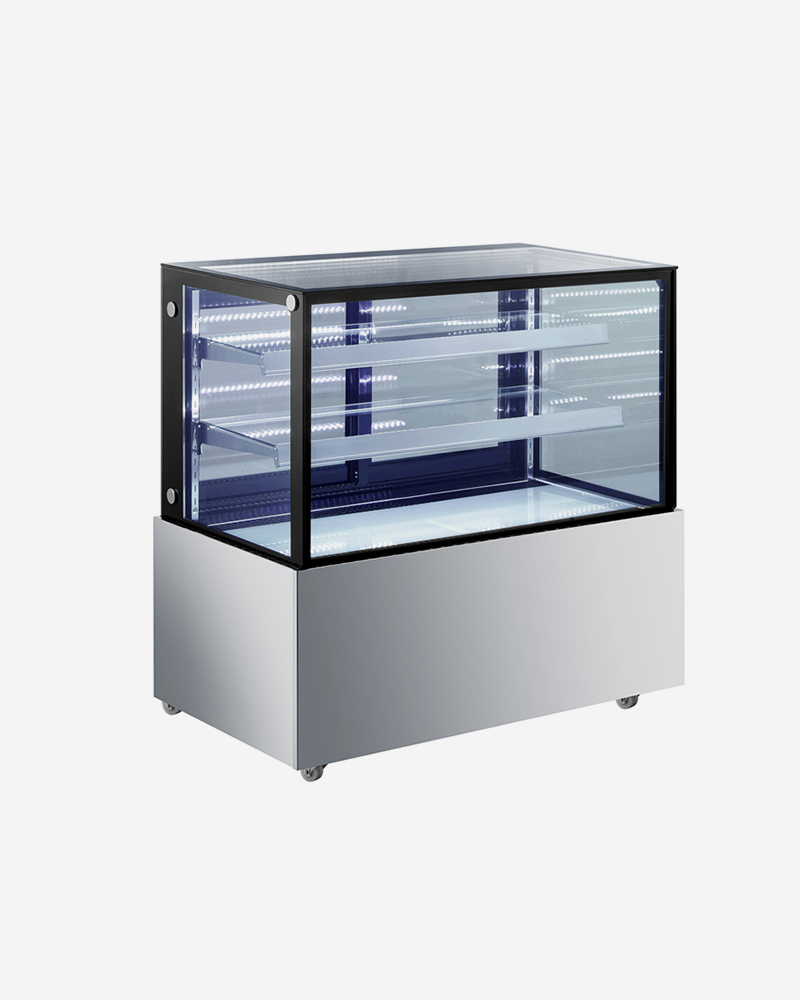 Fan-Cooled Cake Display Cabinet with Steam HumidificationFor bakeries where cakes and pastries are on display all day, this refrigerated showcase with fan cooling and humidification helps protect product texture while keeping shelves visible for easy rotation.View Product →
Sushi and Cold Deli Cases
Sushi counters need a tight, even temperature and a sightline that lets customers see the product without opening a door. Small countertop units work well for a limited menu, while longer cases suit high-volume service.
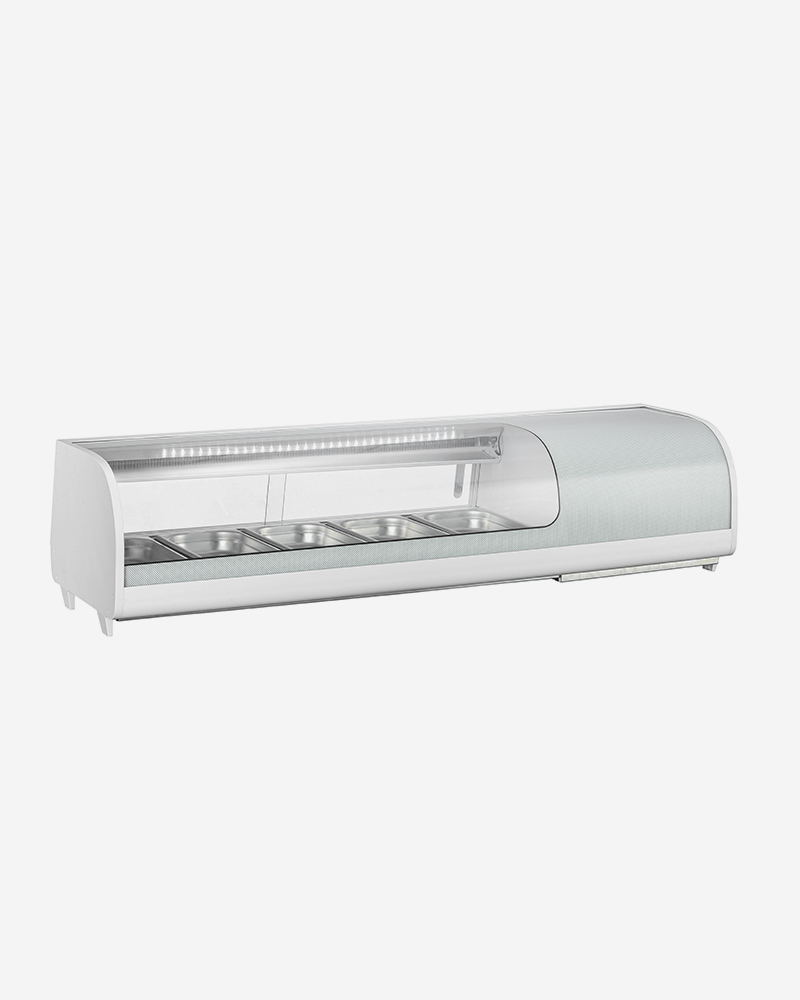 Countertop Sushi Showcase with Digital ThermostatA compact display unit suited for sushi counters, offering even cooling with top and bottom evaporators, clear sightlines, automatic defrost, and internal LED lighting to keep product visible.View Product →
Open Displays and Beverage Zones
Open merchandisers trade a little energy for a lot of impulse buying. Group drinks by category and size, keep front rows fully faced up, and never let warm deliveries go straight onto the shelf. Chill them first so the case is not fighting itself.
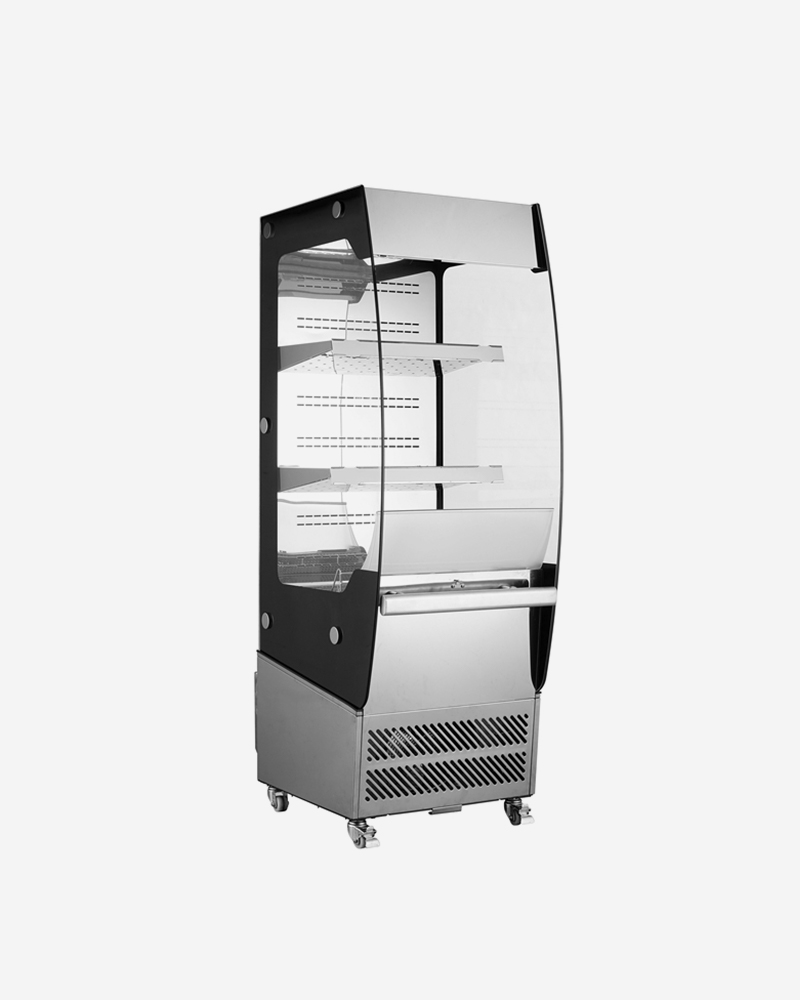 Commercial Open Display Cooler in Stainless SteelAn open merchandiser for high-visibility beverage or product displays, built with stainless steel for durability; ideal for encouraging impulse buys when stock is fully faced and pre-chilled.View Product →
Labeling, FIFO, and the Daily Reset
Organization collapses in three days without a routine. The routine does not need to be complicated; it needs to happen at the same point in every shift.
- Pull forward. At the start of prep, move older stock to the front and load new deliveries behind it.
- Label again. Anything transferred into a new container gets a new label, even if it is only moving a few feet.
- Check temperatures. Record the reading for every cabinet and log anything outside your target range.
- Break down the mess. Fifteen minutes at close, wiping shelves and returning misplaced items, is worth an hour of searching tomorrow.
- Review the map. Once a week, ask the team whether the shelf layout still matches the menu. Menus change, and the fridge should change with them.
Common Mistakes That Cost Restaurants Money
- Storing raw chicken above anything that will not be cooked again.
- Filling a reach-in so tightly that cold air cannot circulate.
- Using opaque containers so nobody knows what is inside.
- Leaving deliveries in boxes on the floor of the walk-in instead of breaking them down.
- Assuming a clean-looking fridge is an organized one. A quick temperature and rotation check tells the real story, and our guide on how to maintain a display cooler in simple steps covers the maintenance side of that routine.
Final Thoughts
A well-organized restaurant refrigerator is a quiet competitive advantage. It shortens ticket times, cuts waste, keeps inspectors satisfied, and helps the equipment last longer. Start with a shelf map, add labels and clear containers, and give your team a five-minute routine at the end of every shift. Do that, and the dinner rush gets a little calmer.
If you are planning a new counter, a bakery display, or a full front-of-house refresh, our team at Ningbo XiangChi Electrical builds commercial display refrigeration for exactly these settings and is always glad to talk through layouts and configurations.
You May Also Like
.jpg?imageView2/2/w/500/h/500/format/jp2/q/100 "Four Sides Glasses Display Cooler")
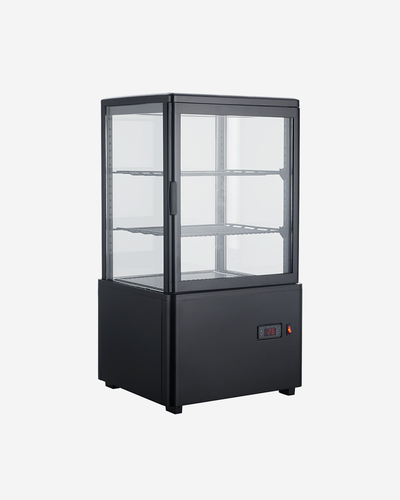
.jpg?imageView2/2/w/500/h/500/format/jp2/q/100 "White 4-Sided Glass Refrigerated Display Case")
.jpg?imageView2/2/w/500/h/500/format/jp2/q/100 "Refrigerated Display Cake Countertop Four Sides Glasses Display Cooler")
.jpg?imageView2/2/w/500/h/500/format/jp2/q/100 "Four Sides Glasses Display Cooler")

-
- Navigation
- Home
- About Us
- Products
- News
- Contact Us
 East Zone, Guanhaiwei Industrial Park, Cixi City, Ningbo, Zhejiang, China
 +86-574-63668678
 +86-574-63668108
Copyright © Ningbo XiangChi Electrical Co.,Ltd All Rights Reserved.
