
 简体中文
 English
 Español

News
drink fridge temp: Applications, Selection Criteria, and Practical Guidance
A cold bottle should feel cold the moment your fingers close around it — not merely cool, and never half-warm at the back of the shelf. That first impression is really a temperature story. Whether you run a convenience store, a café, a bar, or a bakery that sells bottled drinks beside the cakes, the drink fridge temp you choose quietly shapes how your products taste, how long they stay safe, and how much electricity the case draws month after month.
We have spent close to two decades building commercial display coolers, and the questions we hear from shop owners are refreshingly practical: what number should the dial sit at, and why does one shelf always feel warmer than the rest? Here is what we have learned on the factory floor and in the field.
The Range to Aim For: 33°F to 40°F (1°C to 4°C)
Most beverage display cases settle into their sweet spot somewhere between 33°F and 40°F, and the setting we see working hardest in real shops is around 36°F to 38°F. That band is cold enough to keep packaged drinks crisp and perishable ones safe, yet not so cold that cans start to bulge, bottles fog over the instant they leave the case, or the compressor runs without a rest.
For anything perishable — milk-based drinks, fresh juice, smoothies, cold brew with dairy — 41°F (5°C) is a ceiling rather than a target. Food safety guidance treats that figure as the maximum cold-holding temperature, which means a case set at 40°F has almost no margin on a hot afternoon when the door opens every ninety seconds.
A useful way to think about it: the number on the controller is an intention, and the temperature inside the bottle is the reality. The two only agree when airflow, loading, and door habits are all cooperating.
Why Two or Three Degrees Change What Customers Taste
Taste and carbonation
Cold liquid holds dissolved carbon dioxide more readily, so soda poured at 37°F keeps its sparkle far better than soda at 45°F, which foams, fizzes, and goes flat quickly in the cup. Beer is a little more nuanced: a mass-market lager is refreshing at 36°F to 42°F, while a hop-forward ale or a stout loses much of its aroma when served ice cold. Wine sits further up the scale again, which is why a single case set to one number can never flatter every product in it.
Safety and shelf life
Between 41°F and 135°F, bacteria multiply far faster than most people expect. Drinks that contain dairy, fresh fruit, or brewed tea belong firmly in the cold chain, and every degree you shave off the top of the safe range buys you time when a delivery arrives late or a door is propped open during restocking. Even sealed soft drinks benefit: heat accelerates the breakdown of sweeteners and the loss of fizz.
Energy and equipment life
Every 1.8°F (1°C) you drop below what you actually need adds roughly two to three percent to running costs, and it pushes the compressor harder through the summer. Chasing 32°F rarely pays. A well-loaded case held at 37°F will usually outlast one battling to hold 33°F in a warm room.
Matching the Temperature to the Drinks You Sell
If your case holds a mixed range — a few shelves of soda, a row of beer, bottled water, and maybe wine or fresh juice — pick a compromise temperature for the bulk of the volume and move the sensitive items to their own zone. The table below is the starting point we share with most new customers.
| Drink type | Suggested holding temperature | What to watch |
|---|---|---|
| Soda and carbonated soft drinks | 36°F to 40°F (2°C to 4°C) | Cold drinks hold carbonation better |
| Bottled water | 35°F to 39°F (2°C to 4°C) | Keep above freezing to avoid burst bottles |
| Lager and pilsner | 36°F to 42°F (2°C to 6°C) | Too cold mutes malt aroma |
| Ale, stout and craft beer | 45°F to 52°F (7°C to 11°C) | Best in a separate warmer zone |
| White and rosé wine | 45°F to 50°F (7°C to 10°C) | Sparkling styles prefer 40°F to 45°F |
| Milk drinks, juice and smoothies | 33°F to 38°F (1°C to 3°C) | Never above 41°F (5°C) |
When the beer and soft drinks are the backbone of your sales, a dedicated chiller with even airflow front to back keeps every row at the same reading rather than chilling the front and neglecting the back.
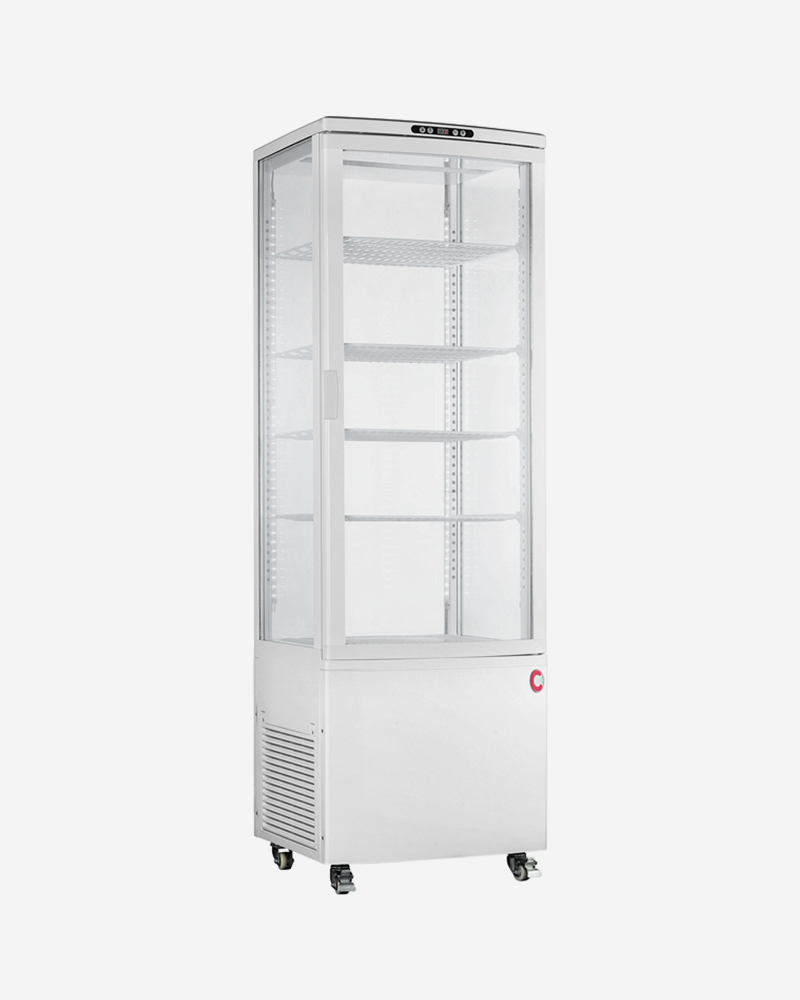 Four-Sided Glass Countertop Beer and Beverage CoolerA 218 L countertop chiller with four-sided glass, digital thermostat, adjustable shelves and ventilated cooling for displaying beer and soft drinks.View Product →
Where Temperature Really Lives Inside a Case
Cold air sinks, and most display coolers rely on a fan pushing air up a rear duct and letting it fall gently over the shelves. That circulation is why the top shelf of an overloaded case is often the warmest spot in the shop, and why stacking bottles flush against the back grille makes the whole cabinet work harder while feeling warmer at the front.
Leave an inch or two of space behind the last row, keep stock below the load line marked on the inner wall, and resist the urge to fill every gap before a busy weekend. If you are deciding between an enclosed case and an open one, this comparison of open versus closed display refrigeration explains how each design moves air and what that means for holding a steady number.
Countertop Versus Open Cases: What Each Means for Temperature Control
Small footprints: countertop and tabletop coolers
In cafés, bars, and bakery counters, a compact case beside the till is often the most practical way to keep drinks within arm's reach. Because the cavity is small and the glass sits close to the product, these units recover temperature quickly after the door closes, which makes them forgiving on a busy morning. Look through our countertop display cooler range to see how door style and shelf layout affect that recovery.
 Compact Countertop Beverage Display Cooler with Sliding DoorsA 135 L countertop cooler with curved tempered glass, sliding rear doors and adjustable shelves, keeping drinks within reach at cafes and counters.View Product →
High-traffic aisles: open display coolers
An open merchandiser invites customers to grab without touching a handle, and that convenience has a temperature cost: the cold air spills out constantly, so these cases work best when the store is air-conditioned, away from doorways, and never loaded past the load line. A high upright model with a strong air curtain holds its reading far better than a shallow unit pushed into a hot corner.
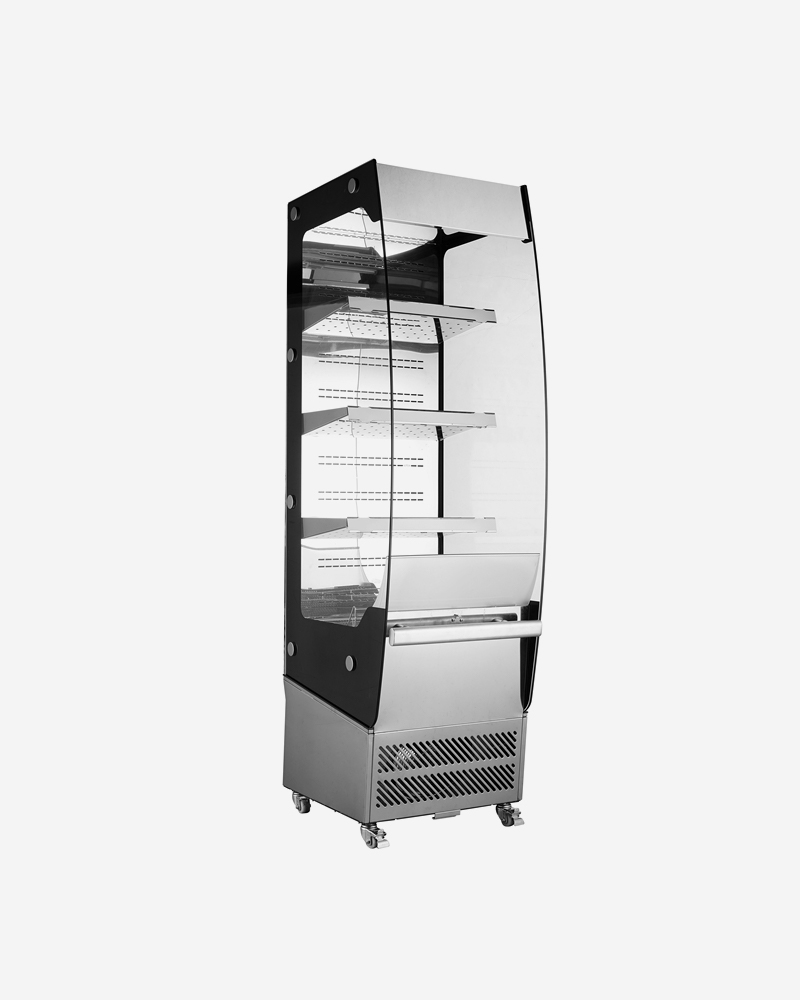 High Upright Open Refrigerated Beverage MerchandiserA 220 L open upright merchandiser with R290 refrigerant for commercial drink display, designed to keep products accessible while maintaining a chilled retail presentation.View Product →
Everyday Habits That Keep the Reading Steady
- Check the real temperature, not just the digital display, using a probe or a glass thermometer placed between two bottles in the warmest spot.
- Take readings at opening, mid-afternoon, and closing — the mid-afternoon number tells you the most.
- Keep the case at least four inches from walls and well away from ovens, fryers, and direct sun.
- Pre-chill warm deliveries in a back room rather than dropping a full crate into the display.
- Wipe door gaskets weekly and close them on a sheet of paper to test the seal.
- Vacuum dusty condenser coils every few months; clogged coils raise both temperature and power bills.
When the Number Creeps Up: A Quick Checklist
- Warm top shelf only: airflow is blocked or the case is overloaded — clear space and recheck within an hour.
- Water pooling inside: a blocked drain or a defrost cycle that is not finishing properly.
- Frost on the rear panel: a worn door seal letting humid air in, or a failing defrost heater.
- Compressor running nonstop: dusty coils, a hot location, or a refrigerant issue worth calling an engineer about.
- Drinks cold but soft drinks flat: the case is fine, the serving temperature is simply too warm for carbonation.
Getting drink fridge temp right is less about chasing an exact figure than about building a small, repeatable routine: choose a sensible range, load the case so air can move, measure with a thermometer you trust, and adjust for what you actually sell. Do that, and the case stops being a background appliance and becomes part of why customers come back for the same cold bottle.
We have been manufacturing commercial display coolers in Ningbo since 2007, and we are always glad to talk through the numbers with shop owners and distributors who want a case that holds its temperature rather than merely claiming it.
You May Also Like





-
- Navigation
- Home
- About Us
- Products
- News
- Contact Us
 East Zone, Guanhaiwei Industrial Park, Cixi City, Ningbo, Zhejiang, China
 +86-574-63668678
 +86-574-63668108

Copyright © Ningbo XiangChi Electrical Co.,Ltd All Rights Reserved.
