
 简体中文
简体中文 English
 Español
News
What temp should Display Warmers be set?
1. What Temperature Should a Display Warmer Be Set At
A commercial display warmer generally needs to hold food at 140°F (60°C) or above, the threshold food safety codes use to separate safe hot-holding from the range where bacteria multiply on a shortening clock. Baked goods and pastries that don't require strict hot-holding compliance are often run cooler than that, somewhere in the 120°F to 130°F band, since the goal there is a warm, inviting product rather than regulatory hot-holding.
The right number shifts with what's actually sitting on the shelf. Fried chicken and rotisserie proteins need steady heat above 140°F through an entire shift, while a case of croissants or muffins holds up better, and tastes better, at a gentler setting that doesn't dry the crumb out. Matching the thermostat to the product category, rather than picking one number for the whole case, is what separates a well-run display from one that quietly loses product to spoilage or staleness.
Quick Fact: Why the Danger Zone Matters
Food held between 40°F and 140°F sits in what health codes call the danger zone, a range where organisms such as Clostridium perfringens can double in number in roughly 20 minutes under favorable conditions. A display warmer drifting even a few degrees below 140°F for an extended stretch during a busy lunch rush is enough to draw attention during a routine health inspection.
2. Recommended Ranges by Product Category
A four-sided glass display warmer handling a rotating mix of items rarely runs at one fixed setting all day. Fried items and hot sandwiches tend to sit toward the top of the range, somewhere between 150°F and 180°F, partly because the higher heat keeps breading crisp and reduces the soggy texture that builds up from trapped steam. Rotisserie chicken and similar proteins do better a notch lower, closer to 140°F to 150°F, since that range preserves moisture over a longer holding period without dipping into unsafe territory.
Pastry cases behave differently. Croissants and muffins hold their texture better around 110°F to 130°F, where warmth and aroma matter more than strict hot-holding rules, and iced or cream-filled items need even less heat, often no more than 85°F to 100°F, since anything higher melts icing and softens fillings within an hour. These figures work as a starting point rather than a fixed rule, since kitchen airflow, door-opening frequency, and how full the case is can shift the internal reading by several degrees in either direction.
3. Factors That Shift the Right Setting for a Given Case
3.1 Glass Construction and Cabinet Design
A four-sided glass unit loses heat faster than a solid-back cabinet because glass conducts warmth outward on several exposed surfaces rather than just the front pane. Cases built this way often need the thermostat set a few degrees higher than an equivalent single-pane unit to hold the same internal food temperature, which matters more in a storefront sitting near an air-conditioning vent or a drafty entrance.
3.2 Humidity Control
Dry heat pulls moisture out of baked goods within an hour or two, which is why many warmers pair a temperature dial with a humidity setting, commonly held around 60% to 70% relative humidity for bread and pastry items. Running that humidity function alongside a moderate temperature setting tends to preserve texture better than simply raising the heat on a dry-only unit.
3.3 Load Size and Product Density
A fully stocked case reaches target temperature more slowly but holds heat more evenly than one with just a handful of items scattered across the shelves. Kitchens that restock in small batches through the day sometimes find the thermostat reading looks correct while items near the glass edges run several degrees cooler than the ones toward the center, a gap that's worth checking with a probe thermometer rather than trusting the panel display alone.
4. Checking and Calibrating the Thermostat
The digital readout on a display warmer measures air temperature inside the cabinet rather than the internal temperature of the food itself, and the gap between the two can run five to fifteen degrees depending on airflow and how packed the shelves are. Getting an accurate read starts with setting the thermostat to the intended range and letting the empty cabinet stabilize for roughly half an hour, then loading it with product and inserting a probe thermometer into the thickest part of a representative item. After another twenty minutes of holding time, comparing the probe reading against the panel display shows whether the dial needs a small adjustment up or down.
Once the probe confirms a safe and appropriate range, logging that working setting gives staff on later shifts a known baseline instead of guesswork. Many kitchens repeat this check seasonally, since a case reading accurately in winter can drift by a few degrees once summer humidity and warmer ambient kitchen air shift the baseline conditions the unit was originally calibrated against.
5. Common Mistakes Worth Avoiding
Setting the dial once and leaving it untouched for months is a habit that causes problems as seasons and product lines shift underneath it. A pattern that shows up repeatedly in commercial kitchens involves staff cranking the temperature up to compensate for a door that gets opened too often, rather than addressing the door seal that's actually the source of the heat loss. Mixed product categories held at a single compromise temperature run into a similar problem, since a setting that suits fried chicken tends to dry out pastries sitting in the same case, and nobody notices the gap between the panel reading and actual food temperature until an inspection brings it up.
Overcrowding shelves to maximize visual appeal creates a related issue, since packed product blocks internal air circulation and produces cold spots near the back or corners of the case. Leaving small gaps between items for airflow, even at the cost of a slightly less full-looking display, tends to keep the entire case within a tighter and more consistent temperature band.
You May Also Like
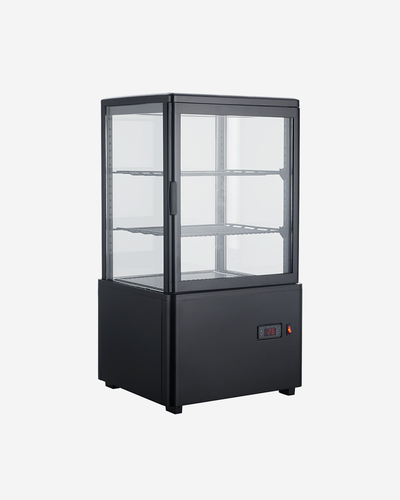
.jpg?imageView2/2/w/500/h/500/format/jp2/q/100 "Four Sides Glasses Display Cooler")
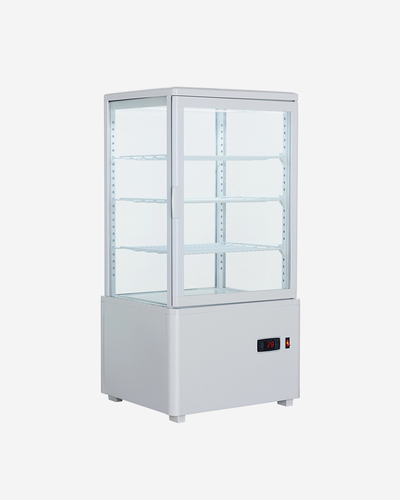
.jpg?imageView2/2/w/500/h/500/format/jp2/q/100 "White 4-Sided Glass Refrigerated Display Case")
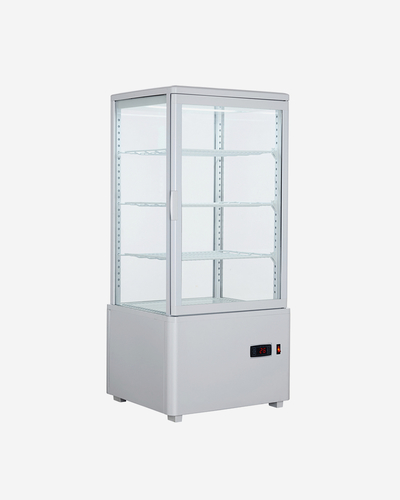
.jpg?imageView2/2/w/500/h/500/format/jp2/q/100 "Refrigerated Display Cake Countertop Four Sides Glasses Display Cooler")
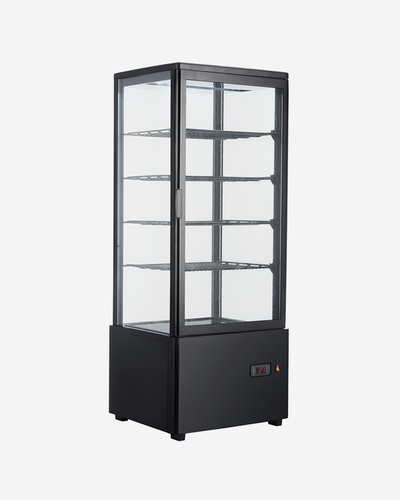
.jpg?imageView2/2/w/500/h/500/format/jp2/q/100 "Four Sides Glasses Display Cooler")

-
- Navigation
- Home
- About Us
- Products
- News
- Contact Us
 East Zone, Guanhaiwei Industrial Park, Cixi City, Ningbo, Zhejiang, China
 +86-574-63668678
 +86-574-63668108
Copyright © Ningbo XiangChi Electrical Co.,Ltd All Rights Reserved.
